


Real Estate Cadastre in the Czech Republic: What It Shows, What It Does Not Resolve, and How It Protects the Owner
The Real Estate Cadastre in the Czech Republic is a public state register containing information about land parcels, apartments, non-residential premises, separate buildings, building rights, and registered rights relating to real estate. Put simply, it is an official database. It records the legal and factual condition of properties to the extent prescribed by law, but it does not issue construction permits, resolve disputes between owners, or verify compliance with every condition of an agreement.
Cadastral information is important when purchasing, selling, inheriting, gifting, or pledging real estate. It can be used to determine who is registered as the owner, whether the property is subject to a pledge, an easement, a prohibition on disposal, or an unfinished procedure to amend the record. However, a cadastral extract alone is not sufficient for a comprehensive review of a property.
What Is the Real Estate Cadastre in the Czech Republic?
The Czech Real Estate Cadastre (katastr nemovitostí) is a public register containing a description of real estate, its geometric and spatial location, registered rights, and other information prescribed by law. The register is maintained by cadastral offices (katastrální úřady), which form part of the Czech Office for Surveying, Mapping and Cadastre (Český úřad zeměměřický a katastrální, ČÚZK).
The principal rules governing the operation of the cadastre are established by Cadastral Act No. 256/2013 Coll. (Cadastral Act No. 256/2013 Coll.). Technical requirements, the scope of recorded data, categories of land, and methods of property use are further regulated by Cadastral Decree No. 357/2013 Coll. (Cadastral Decree No. 357/2013 Coll.).
Anyone may access basic information through the official online service for viewing the Real Estate Cadastre (Nahlížení do katastru nemovitostí). The service can be used to search for land parcels, buildings, individual units, and ongoing cadastral procedures. Access to certain personal information may require authentication or the entry of a security code.

What Is Considered Real Estate Under Czech Law?
To understand how the cadastre works, it is important to distinguish the everyday understanding of real estate from its legal definition. Under the current Czech Civil Code, immovable property includes land parcels, independent underground structures with a separate purpose, rights in rem relating to them, and other assets expressly recognised by law as immovable property (Czech Civil Code).
Under certain circumstances, an independent underground structure may be a wine cellar, a separate infrastructure facility, or another structure that has its own purpose and is not legally treated as an ordinary part of the land parcel. The status of such a structure is always assessed with regard to its construction, purpose, and legal connection to the land.
A building right (právo stavby) is also considered real estate. It is a right in rem that allows one person to have a building above or below the surface of land owned by another person. A building right is recorded in the cadastre as an independent immovable asset.
Individual units in residential and non-residential buildings (jednotky) are also separate items of real estate. These include apartments, offices, studios, workshops, garage premises, and other spatially separate parts of a building. A unit includes not only the premises themselves, but also the corresponding share in the common parts of the building and the land parcel.
Why a Separate House Is Usually Not an Independent Property
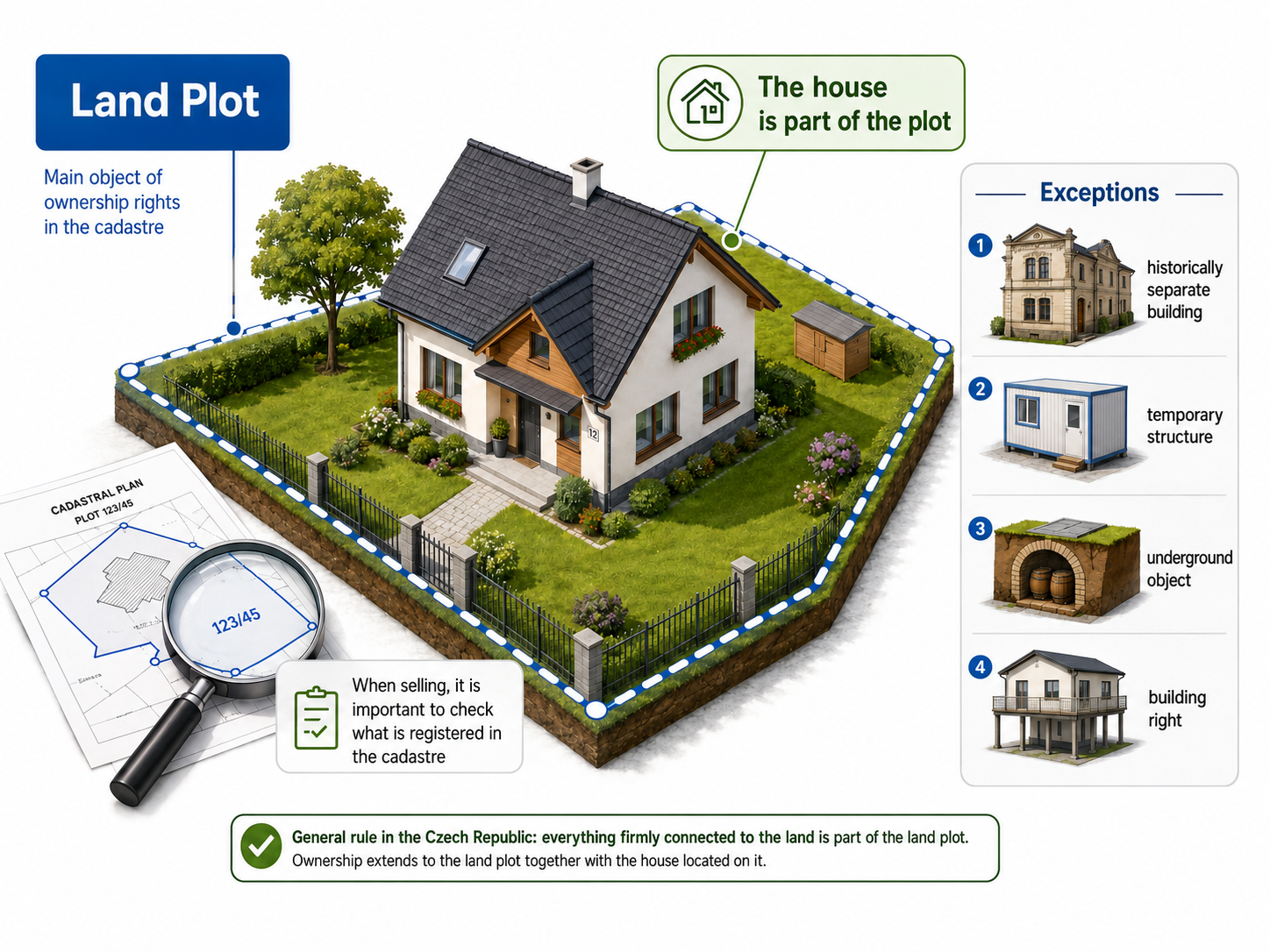
One of the fundamental principles of modern Czech law is that a structure forms part of the land parcel (stavba je součástí pozemku). As a general rule, the owner of the land also owns the house situated on it.
When a family house is sold, the subject of the transaction is generally the land parcel of which the building forms an integral part. The house may still be displayed in the cadastre and have its own descriptive data, but legally it is not necessarily an independent object of ownership.
There are exceptions to this general rule. Certain buildings that historically belong to another owner, temporary structures, independent underground structures, and buildings forming part of a building right may be recorded separately. A property review therefore cannot be limited to an everyday description of the asset. It is necessary to establish exactly which land parcels, buildings, units, and rights are registered in the cadastre.
What Types of Property Are Recorded in the Real Estate Cadastre?
The categories of property recorded in the cadastre are specified in Section 3 of the Cadastral Act. The cadastre records land parcels, certain buildings, individual units, building rights, and other assets where their registration is required by specific legislation.
| Recorded Asset | What It Means | Practical Example |
|---|---|---|
| Land parcel (pozemek) | A geometrically and spatially defined part of the territory with its own parcel number | Land beneath a house, a garden, arable land, or a forest parcel |
| Building (budova) | Recorded separately only in cases prescribed by law | A building owned by another person on someone else’s land |
| Individual unit (jednotka) | Separate real estate within a building together with a share in the common parts | An apartment, office, studio, or garage unit |
| Building right (právo stavby) | A right in rem to have a structure on another person’s land | Construction and operation of a building on land owned by another person |
| Independent underground structure | An underground structure with a separate purpose | An independent wine cellar |
| Rights and restrictions | Legal relationships connected with real estate | Ownership, pledge, easement, or prohibition on disposal |
When preparing an agreement, it is not sufficient simply to state that a house, apartment, or garden is being sold. The property must be described in a way that allows it to be matched unambiguously with the cadastral data. An error in the parcel number, unit designation, or cadastral area may result in the registration procedure being suspended or rejected.
What Information Does the Cadastre Record?
For each property, the cadastre stores a prescribed set of descriptive and graphic information. The register may include the cadastral area, parcel number, area, type of land, method of use, information about the building, the number of an individual unit, and information concerning legal protection.
The cadastre also records information about owners and other entitled persons. For a natural person, the recorded information includes their first name, surname, birth identification number or, where no such number exists, their date of birth, as well as their registered address. For a legal entity, the register includes its name, identification number, and registered office.
Rights and restrictions are recorded in relation to real estate. These may include ownership, a pledge (zástavní právo), an easement or real burden (věcné břemeno), a building right, a prohibition on disposal or encumbrance, an enforcement restriction, and other records prescribed by law.
Warnings concerning unfinished procedures are particularly important. A plomba indicates that a procedure is underway in relation to the property that may change its legal status. A plomba does not mean that the proposed change will necessarily be registered, but it must not be ignored when purchasing real estate.
The Cadastral Map and the Designation of a Land Parcel
The geographic position of properties is shown on the cadastral map (katastrální mapa). It displays parcel boundaries and numbers, the location of buildings, and the relationship between a property and the surrounding area. General information about the operation of the cadastre and cadastral maps is available on the official website of the Czech Office for Surveying, Mapping and Cadastre (ČÚZK).
Each land parcel is assigned a land category (druh pozemku). This may be arable land, a garden, a vineyard, an orchard, permanent grassland, a forest parcel, a water area, a built-up area and courtyard, or other land.
A method of use (způsob využití) may also be recorded for a land parcel, building, or individual unit. For example, a unit may be recorded as an apartment, studio, workshop, or non-residential premises.

Cadastral map – illustrative image
Why the Type of Land Recorded in the Cadastre Does Not Determine Whether Construction Is Permitted
The cadastral classification of a property does not have the same meaning as the functional designation of an area under planning documents. If a parcel is recorded in the cadastre as a garden (zahrada), this does not mean that a family house may automatically be constructed on it. At the same time, the designation “other land” (ostatní plocha) does not in itself prove that construction is prohibited.
The possibility of construction depends on the zoning plan, the character of the area, protection zones, access to infrastructure, the requirements of construction legislation, and the parameters of the specific project. Where necessary, preliminary information may be requested from the building authority (Czech Public Administration Portal).
The cadastral office does not issue construction permits and cannot confirm what type of structure may be built on a parcel. Before purchasing land, the buyer must separately examine the zoning plan, access road, utility connections, height and development density restrictions, protection zones, and the position of the competent building authority.
How Changes Appear in the Cadastre
The cadastre registers changes to rights and information primarily on the basis of documents submitted by parties to legal relationships, courts, notaries, public authorities, and other authorised persons.
For example, an owner may pledge an apartment to a bank. The parties enter into a pledge agreement (zástavní smlouva), after which an application to register the pledge is submitted to the cadastre. If the statutory conditions are satisfied, a record of the pledge in favour of the bank appears in relation to the apartment.
Another example concerns a dispute over ownership. If a court determines who owns a property, the cadastral office amends the record on the basis of the final court judgment. The cadastre itself does not examine the merits of the dispute or decide which party presented the more persuasive arguments.
Documents concerning inheritance, decisions of enforcement authorities, geometric plans, owners’ declarations, and information that public institutions are required to transmit to the cadastre may also serve as the basis for amending a record.
Can the Cadastre Change Information on Its Own Initiative?
The cadastral office may verify and amend certain information through procedures prescribed by law. During a cadastral review, information in the register is compared with the actual condition of the area. The review may concern buildings, parcel boundaries, categories of land, and methods of use.
Cadastral maps, orthophotographs, survey results, and other geodetic materials may be used to identify discrepancies. If a parcel previously registered as arable land is in fact being used as a garden, the cadastral office may initiate a review and request the necessary information or documents.
A satellite image or aerial photograph is not always sufficient grounds for immediately amending a record. The procedure depends on the nature of the discrepancy, the owner’s position, and the availability of documents issued by the competent authorities.
Does the Cadastre Review the Agreement?
The common claim that the cadastre does not review an agreement at all is inaccurate. During the procedure for registering a right, the cadastral office assesses a range of circumstances defined by law.
The cadastre checks whether the document has the required form and mandatory particulars, whether it establishes the claimed right, whether the parties are entitled to dispose of the property, and whether the proposed registration corresponds to the existing cadastral data. Certain obvious obstacles arising directly from the submitted document or from information already registered are also taken into account.
This review is not a comprehensive legal examination of the transaction. The cadastre does not determine whether the buyer paid the agreed purchase price, whether the seller handed over the keys, vacated the apartment, or whether the parties fulfilled their other contractual obligations.
The cadastral office does not carry out a technical inspection of the building, examine the condition of utility systems, or guarantee the absence of hidden defects. A successful registration of a right does not mean that the agreement provides perfect protection for the parties or that all obligations contained in it have been fulfilled.
What the Real Estate Cadastre Cannot Do
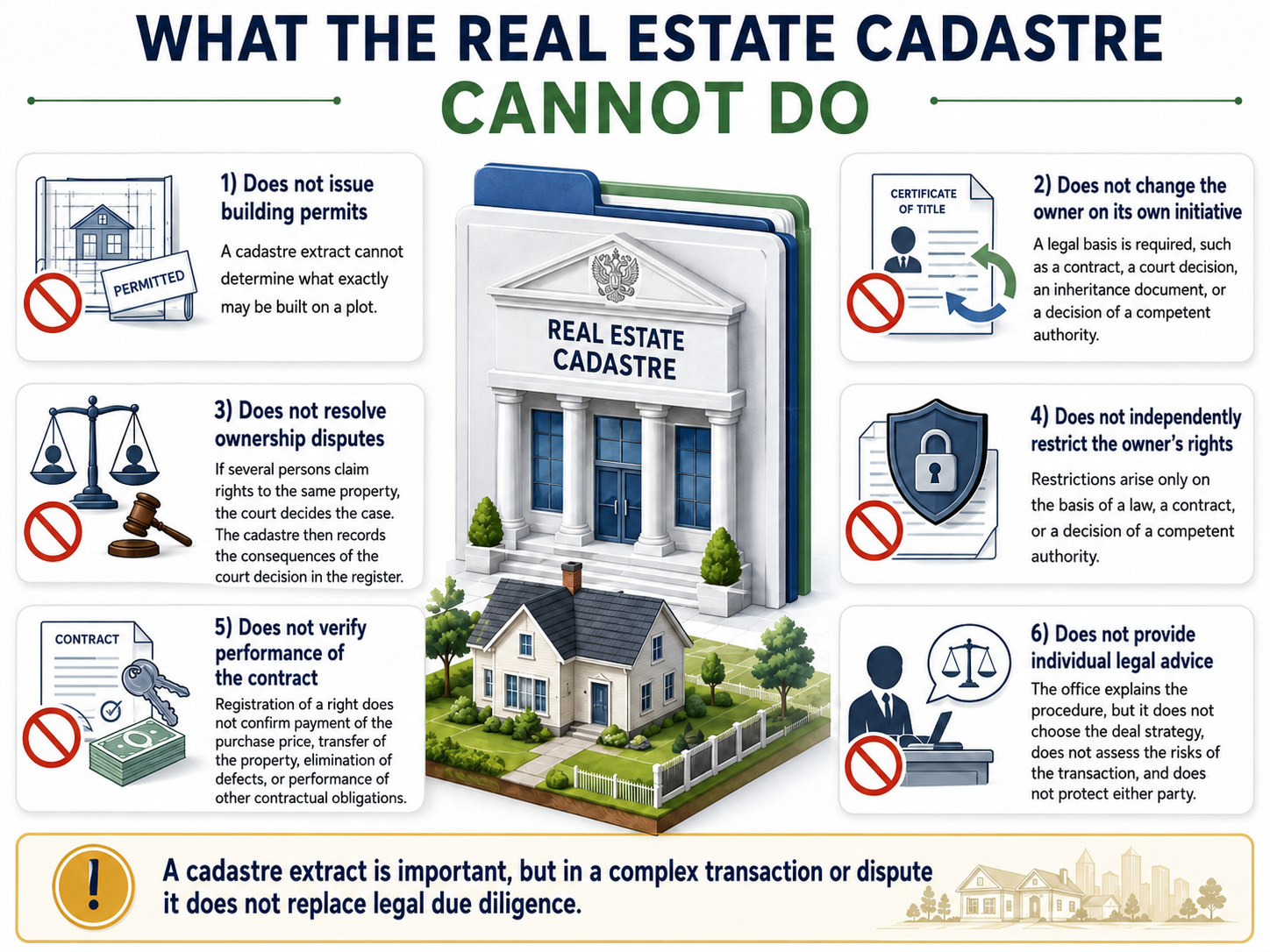
The cadastre does not issue construction permits. A cadastral extract cannot provide a definitive answer as to what house or other structure may be constructed on a parcel.
The cadastre does not change the owner at its own discretion. A change of ownership requires a legal basis prescribed by law, such as an agreement, a court decision, an inheritance document, or a decision issued by a competent public authority.
The cadastre does not resolve ownership disputes. If several persons claim rights to the same property, the court decides the merits of the dispute. The cadastral office subsequently records the consequences of the court decision in the register.
The cadastre cannot independently restrict the owner’s rights. A restriction must arise under the law, an agreement, or a decision issued by an authorised body.
The cadastre does not verify performance of the agreement. Registration of a right does not confirm payment of the purchase price, handover of the property, correction of defects, or performance of other contractual obligations.
The cadastre does not provide individual legal advice. An employee of the office may explain the technical procedure for submitting an application, but is not required to select a suitable contractual structure, assess the risks of a transaction, or protect the interests of one of the parties.
The specific situation always depends on the content of the agreement, registered rights, submitted documents, and factual circumstances. In a complex transaction or dispute, a cadastral extract is not a substitute for a legal review.
Owner Information and Special Considerations for Foreign Nationals
The cadastre is connected to state information systems. If an owner is registered in the Czech population register or in the relevant system for registering foreign nationals, a change of name or address may be transmitted to the cadastre automatically.
In practice, this means that the address stated in an agreement does not always become the primary source of information. If the state register contains current information about a person’s registered residence, the cadastral office may use that information instead.
In our practice, we have encountered situations in which a foreign national’s overseas address was stated in an agreement even though the Czech information system already contained a valid residential address in the Czech Republic. As a result, the cadastre transferred the information from the state register into the record rather than the address stated by the parties in the agreement.
What Should a Foreign National Without Registration in the Czech Republic Do?
If a foreign property owner is not registered in the relevant Czech information systems, their information may not be updated automatically. If the spelling of their name in a foreign passport, residential address, or other identifying information changes, the cadastral office must be notified and supporting documents must be provided.
Particular attention should be paid to changes in the transliteration of a first name or surname. Even a minor difference in spelling may complicate identification of the owner during a subsequent sale, gift, inheritance procedure, or registration of a pledge.
If a foreign national loses or terminates their right of residence in the Czech Republic, the previous address in the cadastral records may be replaced by the note “Residence in the territory of the Czech Republic terminated” (Zrušen pobyt na území ČR). This note does not terminate ownership, but it may indicate a problem with the accuracy of the contact details and the delivery of official correspondence.
When Did the Cadastre Begin Requesting Citizenship Information?
The mandatory inclusion of a natural person’s citizenship in an application for the registration of a right was introduced on October 1, 2025. The Czech Office for Surveying, Mapping and Cadastre published an explanation of this change (ČÚZK).
This does not mean that citizenship has become an ordinary publicly displayed item in a cadastral extract. It is used as an additional identifying detail during the procedure for registering a right.
Before the new requirement was introduced, the cadastre did not possess complete, uniform, and verifiable information about the citizenship of all owners. During public discussions in 2022 concerning possible restrictions on holders of certain passports, it was therefore impossible to determine the citizenship of every owner solely from cadastral data.
Why Foreign Property Owners Should Keep Their Information Up to Date
For a foreign national without a Czech identification number, the principal identifiers may be their name, date of birth, and address. In theory, people with the same names and dates of birth may exist in different countries.
A matching name and date of birth do not allow a person with identical details to lawfully sell someone else’s property. A fraudulent transaction would require forged documents, unlawful certification of a signature, or another serious violation. Outdated information about the owner may, however, make it more difficult to identify a problem in time.
After an application to change a right has been submitted, the cadastre marks the property with a plomba and sends a notification to the owner. A new right is registered only after the statutory protection period. This system is effective provided that the owner actually receives the correspondence.
If a person leaves the Czech Republic, fails to renew their residence permit, or changes their overseas address without reporting it, an official letter may not reach them in time. This increases the risk that a suspicious procedure will be discovered too late.
How to Protect Real Estate and Monitor Cadastral Records
Owners are advised to check their property in the cadastre regularly and ensure that their name, address, and other identifying information remain up to date. If the information is not updated automatically through state registers, changes must be reported directly.
A useful tool is the cadastral change monitoring service (Služba sledování změn). It informs the owner about new plombas, newly initiated procedures, registered rights, and other changes (ČÚZK change monitoring service).
To protect real estate, it is advisable to:
- regularly review the cadastral extract;
- monitor the appearance of new plombas;
- report changes to a name, passport details, and address;
- ensure that mail is received at the registered address;
- check messages in email and the datová schránka;
- activate the cadastral change monitoring service;
- respond immediately to an unknown cadastral procedure;
- use accurate identification of the parties and proper certification of signatures.
Practical Conclusion
The Real Estate Cadastre in the Czech Republic should be understood as a state registration system rather than a universal authority responsible for resolving every issue connected with real estate. It shows which properties exist in the register, who is recorded as the owner, which rights and restrictions are registered, and whether new procedures are underway in relation to the property.
At the same time, the cadastre does not confirm whether construction is permitted, does not replace the zoning plan, does not inspect the technical condition of the property, and does not guarantee performance of an agreement. It also does not resolve ownership disputes or provide comprehensive legal advice.
At Get Home, we consider a cadastral extract to be the essential starting point for reviewing real estate. It must then be followed by an analysis of the agreements, the legal basis on which the property was acquired, the zoning plan, registered restrictions, actual use, and the accuracy of the information relating to all parties to the transaction.
For a foreign owner, it is particularly important to keep their name and address up to date. A properly registered right must not only be established, but also monitored. The owner should receive official correspondence, notice new plombas, and report promptly any changes that are not transmitted to the cadastre automatically.
Frequently Asked Questions About the Real Estate Cadastre in the Czech Republic
Can Real Estate Be Checked Free of Charge in the Czech Cadastre?
Yes. Basic information about land parcels, buildings, individual units, and building rights is available through the official service (Nahlížení do katastru nemovitostí). Viewing certain personal information may require authentication or a security code.
Does the Cadastre Show Whether a House Can Be Built on a Parcel?
No. The type of land and its method of use recorded in the cadastre do not constitute a construction permit. The zoning plan, construction restrictions, protection zones, infrastructure, and requirements of the building authority must be checked separately.
Does the Cadastre Verify the Legality of a Purchase Agreement?
The cadastre reviews an agreement only to the extent prescribed by law. It assesses the form of the document, the presence of mandatory particulars, the ability to dispose of the property, and whether the proposed entry corresponds to the current records. It does not carry out a complete legal review of the transaction or verify performance of the parties’ obligations.
Can the Cadastre Independently Deprive a Person of Ownership?
No. A change of ownership requires a legal basis, such as an agreement, court decision, inheritance document, or decision issued by a competent public authority. The cadastre cannot change ownership solely on its own initiative.
Is a Family House a Separate Item of Real Estate?
As a general rule, a family house forms part of the land parcel. Buildings falling within statutory exceptions may be recorded separately.
Does a Foreign National Need to Notify the Cadastre About a New Passport?
If a change of name or other information is not transmitted automatically from Czech state registers, the owner should notify the cadastral office and provide supporting documents.
What Does the Note Zrušen pobyt na území ČR Mean?
It means that the person’s registered residence in the Czech Republic has been terminated. The note does not deprive the person of ownership, but it may indicate that there is no current address for the delivery of correspondence.
How Can I Find Out Whether Someone Is Trying to Change the Record for My Apartment?
When a procedure begins, a plomba appears in relation to the property. The cadastre also sends a notification to the owner. Additional protection is provided by the change monitoring service, which sends electronic notifications about new cadastral procedures.
Note
The information in this article is provided for general educational purposes and does not constitute individual legal, tax, or investment advice. The legal assessment of a particular situation depends on the content of the agreements, cadastral records, documents, status of the parties, and other circumstances. Before completing a real estate transaction or submitting documents to the cadastre, it is advisable to obtain a consultation and review the current version of Czech legislation.