


20-Day Period in the Czech Cadastre: Why a Plomba Is Needed and What Can Stop the Transaction
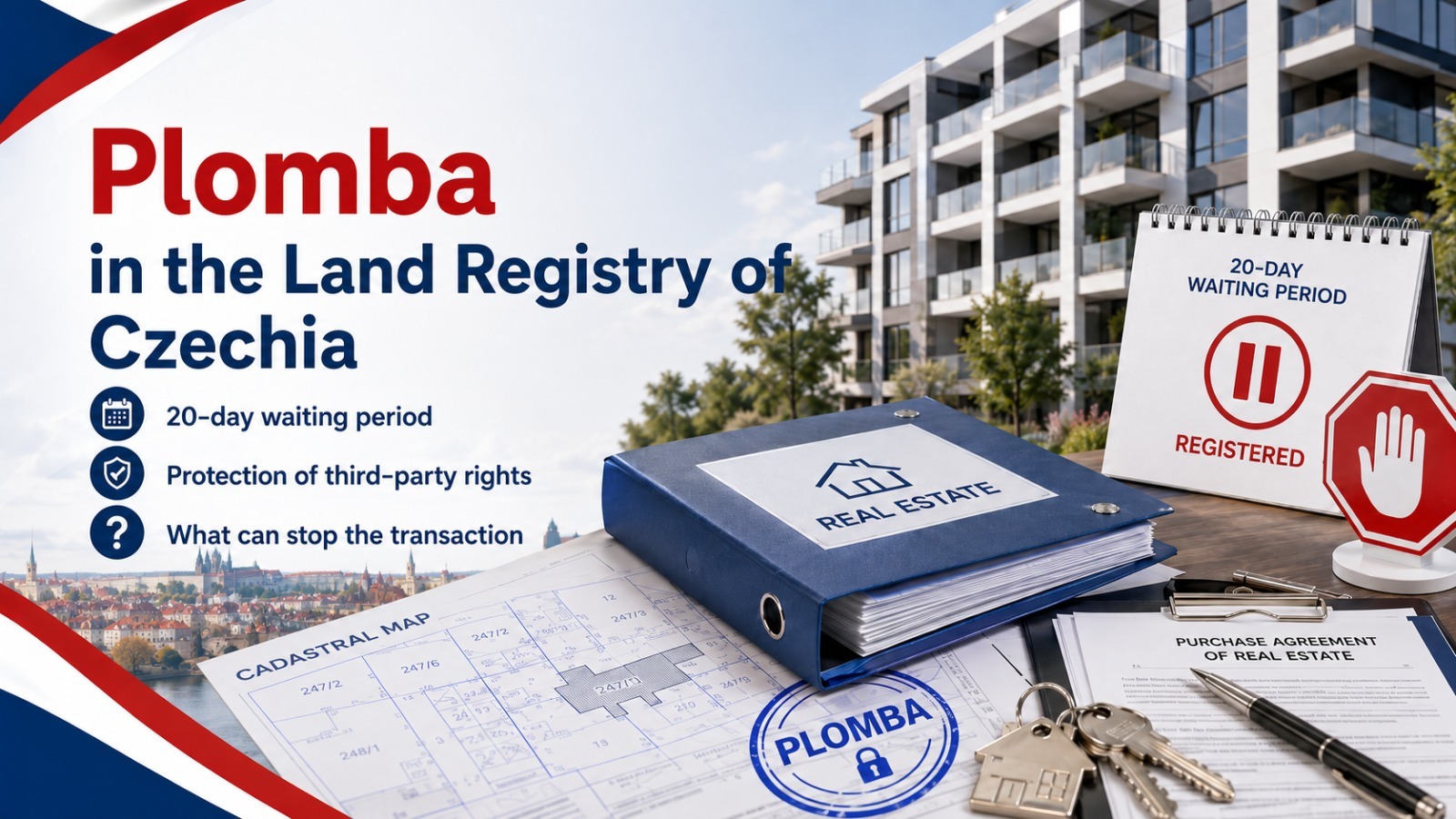
After a purchase agreement has been signed, ownership of real estate in the Czech Republic does not automatically pass to the buyer. The documents are first submitted to the Real Estate Cadastre (katastr nemovitostí), a plomba appears in the property record, and a mandatory waiting period then begins. During this period, the cadastral office is not permitted to issue a final decision allowing the registration of the new ownership right.
At Get Home, we view these 20 days not as a formal delay, but as an important part of protecting the transaction. It is during this period that errors in the documents, restrictions on the disposal of the property, or claims by third parties may be discovered. Buyers therefore need to understand not only how long the procedure takes, but also what the cadastre examines, who may intervene in the registration, and why the transfer of ownership sometimes takes longer than expected.
Not every change to information concerning real estate is recorded in the same way. Rights in rem are generally registered through the entry of a right in the cadastre (vklad práva do katastru). The technical characteristics of a building may be changed through another cadastral procedure, while enforcement proceedings or a court-ordered prohibition are recorded in the form of a special note (poznámka). The mandatory 20-day protection period applies specifically to the procedure for registering a right (vklad) (ČÚZK).
What Changes Must Be Recorded in the Real Estate Cadastre
The cadastre must reflect the current legal and factual condition of the property. If information about the property changes as a result of construction, renovation, division of a building, or the conclusion of a transaction, the owner must ensure that the changes are recorded. The specific set of documents required depends on the nature of the change.
| What Has Changed | Documents Usually Submitted | What Is Registered |
|---|---|---|
| The shape, dimensions, building footprint, floor area, or permitted use of the building | A geometric plan (geometrický plán), an occupancy approval decision (kolaudační rozhodnutí), previously also an occupancy consent (kolaudační souhlas), and documents issued by the building authority | A change to the technical information concerning the property |
| The building has been divided into apartments or commercial premises | The owner’s declaration dividing the building into individual units (prohlášení vlastníka) and the attachments required by law | The creation of separate cadastral units and the associated ownership shares |
| The owner of the property is changing | A purchase agreement (kupní smlouva), gift agreement (darovací smlouva), agreement on the settlement of co-ownership (dohoda o vypořádání spoluvlastnictví), agreement on the settlement of the spouses’ community property (dohoda o vypořádání SJM), inheritance order (usnesení o dědictví), or a court judgment determining ownership (rozsudek o určení vlastnického práva) | A new ownership right |
| An encumbrance is being created | A pledge agreement (zástavní smlouva), or an agreement establishing an easement or other real burden (smlouva o zřízení služebnosti nebo věcného břemene) | A pledge, easement, or another right in rem |
| Enforcement proceedings have been initiated against the owner | A notice of the commencement of enforcement proceedings (vyrozumění o zahájení exekuce) | A note concerning enforcement proceedings (poznámka) |
If the external outline of a building has changed following renovation, a new plan of the interior premises alone is generally insufficient. The cadastre requires a document that makes it possible to link the new condition of the building precisely to the land parcel and the existing cadastral map.
A change in internal floor area does not in itself always result in a change to the cadastral information. What matters is whether the renovation affects information that is actually registered in the cadastre, such as the outline of the building, its permitted use, the number of units created, or the description of individual premises.
When a building is divided into apartments and commercial premises, the owner’s declaration (prohlášení vlastníka) becomes the key document. It defines the individual units, the common parts of the building, and the owners’ shares in the common property. The Czech Office for Surveying, Mapping and Cadastre explains the documentary requirements for changes to information concerning a building (ČÚZК).
How the Vklad práva do katastru Procedure Begins
Changes to rights in rem are registered by the cadastre through a special procedure for the entry of a right in the cadastre (vklad práva do katastru). The procedure is governed by strict rules established by the Cadastral Act (katastrální zákon) and the Cadastral Decree (katastrální vyhláška).
For the cadastre to begin its review, an application for the registration of a right (návrh na vklad) must be submitted. A document establishing the legal basis for registration must be attached. This may be an agreement, an inheritance order, a court decision, an agreement on the division of property, or another document suitable for cadastral registration.
The application may be submitted by the parties to the relevant legal relationship, one of them, or an authorised representative. Another person may physically deliver the documents to the cadastral office, but this does not make that person a party to the procedure. Once a properly completed application has been received, the cadastre is required to review it (ČÚZK instructions for completing the návrh na vklad).
The mere submission of an application does not mean that the right will be registered. The cadastre reviews the attached documents and verifies their compliance with formal and legal requirements. The documents must clearly identify the parties, the property, the right to be registered, and the intention of the parties. If this information is missing or contradictory, the cadastre may refuse to register the change.
There is a well-known case in which a gift agreement in the Czech Republic was prepared in the form of a comic strip. Despite its unusual form, the cadastre registered the transfer of ownership because the document contained all the information required by law. This example clearly demonstrates the basic principle: the appearance of an agreement may be unconventional, but its legal content must remain precise, complete, and unambiguous (iDNES.cz).
What a Plomba Means in the Real Estate Cadastre
Once the procedure has begun, a plomba appears in the property record. It warns the owner, the buyer, banks, and other users of the cadastre that the information concerning the property may change.
At the same time, the case is assigned a registration number, which may look as follows: V-XXXXX/2026-101. The letter V indicates a procedure for the registration of a right (vklad). XXXXX is the sequential number of the application in the relevant calendar year. The number 2026 indicates the year of submission, while the final digits refer to the code of the cadastral office.
Code 101 is used for the Prague cadastral office. The code will differ in other regions and cadastral offices. The case number can be used to monitor the status of the procedure and distinguish one application from another (ČÚZK).
In everyday language, people often say that the 20-day period begins when the plomba appears. Legally, it is more accurate to say that the cadastre may approve the registration of the right only after 20 days have elapsed from the date on which notice was sent to the persons whose rights are affected by the procedure. The plomba and the notice belong to the same initial stage, but the information in the particular case file must be used when determining the exact date on which a decision may be issued (Cadastral Act).
Why the Cadastre Must Wait 20 Days
The Cadastral Act prohibits the cadastre from approving the registration of a right before the prescribed protection period has expired. The parties to the transaction cannot waive this period, cancel it by means of a joint declaration, or shorten it through an additional agreement.
It does not matter how urgently the buyer needs the ownership right to be registered, how much the property is worth, or how quickly the parties are prepared to provide additional documents. The period cannot be accelerated through personal connections, informal arrangements, or an additional payment.
This pause allows the current owner and other affected persons to become aware of an attempt to change the registered rights. Such protection is particularly important in cases involving a forged signature, the use of an invalid power of attorney, a dispute concerning the spouses’ community property, or an attempt to dispose of real estate in breach of a court restriction (Cadastral Act).
The expiry of the 20-day period does not mean that the right will automatically be registered on the twenty-first day. The cadastre reviews the documents at the same time and may complete the procedure only after the protection period has expired and all other statutory conditions have been satisfied.
Who Can Attempt to Stop the Registration
Third parties who believe that the proposed change infringes their lawful rights may seek judicial protection. These may include the seller’s current or former spouse, children, potential heirs, creditors, co-owners, or other persons with legally substantiated claims.
In certain situations, a neighbour may bring a claim on the grounds that the owner caused damage and is required to compensate it. However, a simple expression of dissatisfaction is not sufficient. A mechanism provided by law must be used to impose an effective restriction on the disposal of the property.
One of the main instruments is a preliminary injunction (předběžné opatření). A court may temporarily prohibit the owner from selling, gifting, mortgaging, or otherwise disposing of the property until the dispute has been resolved.
A preliminary injunction may be requested even before the main court proceedings begin. The applicant does not need to have a final or enforceable court judgment in advance. The applicant must explain which right requires urgent protection and why there would be a risk of significant harm without the temporary restriction (Czech Code of Civil Procedure).
Any person claiming that their rights have been infringed or are under threat may apply to the court. This does not mean that the court will automatically grant the application. The court assesses the circumstances presented and decides whether there are lawful grounds for imposing a temporary prohibition.
If the court prohibits the disposal of a specific property, the relevant information will be transmitted to the cadastre. Such a restriction may stop or make it impossible to complete an already pending procedure for the registration of a right.
Can the Risk of a Předběžné opatření Be Identified in Advance?
Checking the title sheet (list vlastnictví), plombas, pledges, easements, and enforcement notes is an essential part of preparing a transaction. However, the cadastre only shows restrictions that have already been registered or procedures that have officially begun.
There is no public register of former spouses, potential heirs, dissatisfied neighbours, undisclosed creditors, or legal claims that have not yet been formally asserted. In some cases, even the seller may not know that a third party is preparing to apply to the court.
For this reason, the purchase agreement includes written representations from the seller confirming that the seller is entitled to dispose of the property, that the property is not the subject of an undisclosed dispute, and that there are no unreported encumbrances, family-related obstacles, agreements with third parties, or other circumstances capable of preventing registration.
A breach of these representations may result in contractual penalties, an obligation to compensate the damage, the possibility of suspending the release of the purchase price from notarial, attorney, or bank escrow, and the buyer’s right to withdraw from the agreement.
These provisions do not guarantee that a dispute will never arise. Their purpose is to allocate risks in advance and provide the buyer with a clear protection mechanism. The specific content of the agreement always depends on the property, the seller’s family circumstances, the financing method, and other circumstances of the transaction.
What Happens After the 20-Day Period Ends
If no obstacles arise during the protection period and the submitted documents comply with the requirements, the cadastre may approve the registration of the right no earlier than the twenty-first day.
The procedure is generally completed within 30 days. However, complex documents, a heavy workload at the cadastral office, several related applications, or the need to supplement the file may cause delays. According to the Czech Office for Surveying, Mapping and Cadastre, the average duration of a registration procedure in May 2026 was 22 days (ČÚZK).
The legal effects of a successful registration generally relate back to the moment when the application was received by the cadastre, rather than the date on which the final decision was issued. Where several applications are submitted in succession, the order in which they were received is therefore particularly important (Cadastral Act).
A delay after the twentieth day does not necessarily indicate a serious problem. It may be caused by a complex transaction structure, multiple properties, the simultaneous registration of a pledge, or the need to wait for additional documents. The parties should monitor the status of the case and respond promptly to official communications from the cadastre.
What Happens If the Cadastre Finds Errors
If the cadastre identifies a defect that can be remedied, it may invite the parties to provide additional information or correct the documents within the permitted limits. For example, it may be necessary to provide a missing attachment, power of attorney, consent, or clarification that does not alter the substance of the parties’ declaration of intent.
However, not every error can be remedied after the application has been submitted. Critical defects include an incorrect identification of the property, the absence of a required declaration of intent, a contradiction between the agreement and the application, a missing signature, or the absence of the document on which the registration of the right is based.
In such situations, a simple explanation or supplementary letter is generally insufficient. The cadastre cannot independently amend the content of the agreement, select a different property on behalf of the parties, or supply the missing consent of a party to the transaction (Cadastral Act).
When a Zpětvzetí návrhu na vklad Is Necessary
If it becomes clear during the review that the documents contain a critical error and the cadastre will not be able to approve the registration of the right, it is often more advantageous for the parties to withdraw the submitted application. Such a withdrawal is called zpětvzetí návrhu na vklad.
The application may be withdrawn only with the consent of all parties to the procedure. The buyer or seller cannot unilaterally terminate a jointly initiated case if the other parties do not agree to the withdrawal (ČÚZK).
In practice, the withdrawal should preferably be completed before a final refusal decision is issued. Following a refusal, a period begins during which the decision may be challenged before a court. A new application concerning the same property may be submitted, but its review may be suspended until the appeal period expires or, if legal proceedings are initiated, until the court dispute has been finally resolved.
As a result, the property may effectively remain blocked for several months. It is therefore not advisable to wait for a formal refusal if the critical error has already been confirmed, all parties are willing to cooperate, and the documents can be promptly prepared again.
The appropriate strategy depends on the nature of the error, the stage of the procedure, and the terms of the signed agreement. Before withdrawing the application, it is also necessary to check whether the withdrawal will affect the escrow of the purchase price, bank financing, the deadline for handing over the property, or the parties’ obligations.
Practical Conclusion
The 20-day period in the Czech cadastre cannot be accelerated, cancelled, or circumvented. It protects the owner and other affected persons against an unlawful change to registered rights.
For the buyer, this means that the purchase price should remain in secure escrow until the agreed conditions have been fulfilled. The status of the property should be monitored not only before the agreement is signed, but throughout the entire cadastral procedure.
The agreement should address a refusal by the cadastre, the appearance of new restrictions, inaccurate representations by the seller, breaches of obligations, and the procedure for returning the funds. Before the documents are signed, it is necessary to review the current title sheet, the legal basis on which the seller acquired the property, the seller’s family circumstances, powers of attorney, and obligations connected with the property.
A secure transaction is based not on the hope that nothing will happen during the 20-day period, but on a thorough preliminary review and properly prepared documents. The more precisely the parties define the property, the payment terms, the registration procedure, and the consequences of potential problems, the lower the risk of the property being blocked for an extended period and of financial losses.
Frequently Asked Questions About the 20-Day Cadastre Period
Are Calendar Days or Business Days Counted?
The rule does not refer to 20 business days. General rules for calculating time limits apply when determining the exact date, including rules for cases in which the final day falls on a weekend or public holiday. The date on which the notice was sent and the information in the specific cadastral case must be used as the reference point.
Can I Pay for an Accelerated Registration?
No. The administrative fee is required to initiate the standard procedure, but it does not entitle the applicant to receive a decision before the mandatory protection period has expired.
Does a Plomba Mean That There Is a Problem with the Property?
No. A plomba also appears in connection with an ordinary sale, a gift, the registration of a pledge, or the creation of an easement. It means that the cadastre is reviewing a change. To assess the situation, it is necessary to check the case number and the legal basis for the proposed entry.
Can a Neighbour Stop the Sale by Sending an Ordinary Letter?
As a general rule, no. An effective prohibition on the disposal of the property requires a legally binding measure, such as a preliminary injunction issued by a court (předběžné opatření). The neighbour must substantiate the claim, and the final decision is made by the court.
What Should Be Done If the Cadastre Requests Additional Documents?
The first step is to determine whether the error can be remedied. Missing attachments or individual pieces of information can sometimes be supplied. However, the absence of a declaration of intent, an incorrect identification of the property, or a material contradiction in the agreement cannot safely be corrected by means of an ordinary explanatory letter.
Can a New Application Be Submitted Immediately After a Refusal?
A new application may be submitted, but the subsequent procedure concerning the same property may be suspended because of the period available for challenging the previous refusal before a court. If the decision is challenged, the waiting period may continue until the court proceedings have been completed.
Can It Be Guaranteed in Advance That No One Will Apply to the Court During the 20-Day Period?
No. A review of the cadastre and other available registers can reveal existing restrictions, but it does not show claims that have not yet been formally asserted. The agreement should therefore contain representations by the seller, penalties for providing inaccurate information, and a mechanism for returning the purchase price.