


Return of Interest on a Rental Deposit in the Czech Republic
The issue of returning interest on a rental deposit in the Czech Republic regularly causes disputes between tenants and apartment owners. Most often, this topic becomes visible after discussions on social media, where one tenant writes that they demanded interest on the deposit for several years of tenancy, and others learn about this right for the first time. Because of this, many people think the rule appeared recently. In fact, the obligation to return a monetary deposit with interest has been in force since 2014, after the Czech Civil Code No. 89/2012 Sb. came into effect, which is still often referred to as the “new Civil Code” (source).
In Czech practice, the familiar word kauce means a deposit or security deposit. In the law itself, the term jistota is used, meaning monetary security or a monetary deposit. In essence, this is the amount that the tenant gives to the landlord as a guarantee of rent payment, utility payments, services, and possible damage to the apartment. However, it is important to understand that this monetary deposit remains the tenant’s money. The landlord may use it only within the limits of the law and the lease agreement, and upon the end of the tenancy must carry out a settlement.

Why the Tenant Has the Right to Interest on the Monetary Deposit
The key provision is found in § 2254 of the Czech Civil Code. It states that the tenant is entitled to interest on the monetary deposit from the moment it is provided, at least at the statutory rate. In Czech, this is worded as follows: „Nájemce má právo na úroky z jistoty od jejího poskytnutí alespoň ve výši zákonné sazby.“ In other words, the tenant is entitled to interest on the deposit starting from the moment the money is handed over to the landlord (source).
The logic of this provision is clear. If a tenant has handed over, for example, 50,000 or 80,000 Kč as a deposit, they cannot use that money throughout the entire term of the lease. In the case of a long-term tenancy, this may be not just several months, but several years. Therefore, the law treats interest as compensation for the fact that the tenant’s money was being held by the other party.
At the same time, interest on the deposit is not a penalty for the landlord. It is not a sanction and not an additional payment “on top of the agreement.” It is the legal consequence of the landlord holding someone else’s funds as security under the lease agreement.
Can the Agreement State That Interest Will Not Be Returned
In practice, lease agreements sometimes include wording that the monetary deposit does not bear interest or that the tenant has no right to interest. For a landlord, such a phrase may seem like a convenient solution, but in the case of residential leases it does not always have legal effect.
Here, § 2235 of the Czech Civil Code is important. It protects the tenant in the lease of an apartment or house for residential purposes and establishes that arrangements which reduce the tenant’s rights in the relevant section of the law are disregarded. In other words, if a residential lease agreement attempts to deprive the tenant of a right that is expressly provided by law, such wording has no legal effect (source, source).
This is especially important specifically for residential leases. If we are talking about an apartment that is being provided to satisfy the tenant’s housing needs, tenant protection is stronger than in ordinary commercial relationships. Therefore, the condition “the deposit is returned without interest” should not be seen as a final resolution of the issue. In a dispute, not only the text of the agreement will matter, but also the mandatory provisions of civil law, and the law takes priority.
The Main Problem: The Law Refers to Interest but Does Not Provide a Simple Rate
The most difficult question is not whether interest on the deposit exists. The right to interest is provided by law. The main question is different: what rate should be applied if it is not specified in the agreement.
Section 2254 refers to a statutory rate, but no special rate specifically for interest on a monetary deposit in residential tenancy is expressly established in the law. Therefore, in practice, the parties often turn to § 1802 of the Civil Code. This provision states that if interest is not determined, the debtor pays customary interest as charged by banks on loans in the place of residence or registration of the debtor at the time the agreement was concluded (source, source).
At first glance, this seems to provide an answer. But in reality, several questions arise. Which bank loans should be treated as the benchmark? Mortgage loans? Consumer loans? Credit cards? Short-term unsecured loans? The difference between these rates can be substantial. That is why lawyers for tenants often try to calculate interest using a higher rate, while landlords, on the contrary, look for a more moderate approach.
Precisely because of this uncertainty, the amount of interest often becomes a subject of negotiation. In the absence of a pre-agreed rate, each party may justify its position, but there is no universal simple formula for all cases.
How Interest on a Deposit Is Usually Calculated
In everyday and contractual practice, interest is most often calculated as simple interest. This means that interest is accrued on the original deposit amount, rather than being capitalized each year. Put simply, the interest is not added to the principal for the purpose of charging interest on interest.
For example, if a tenant paid a monetary deposit of 60,000 Kč and lived in the apartment for four years, then even at a moderate rate the amount of interest may become significant. At an assumed annual rate of 5%, simple interest would amount to around 12,000 Kč. If the deposit was equal to two or three monthly rent payments, and the tenancy lasted several years, the total amount of interest could reach tens of thousands of crowns.
If, however, the deposit amount was small and the tenancy was short, a dispute over interest often makes little practical sense. When the amount involved is just several hundred or a small number of thousands of crowns, the parties usually try to settle without going to court. But in the case of a long tenancy and a high deposit, interest becomes a real financial issue.
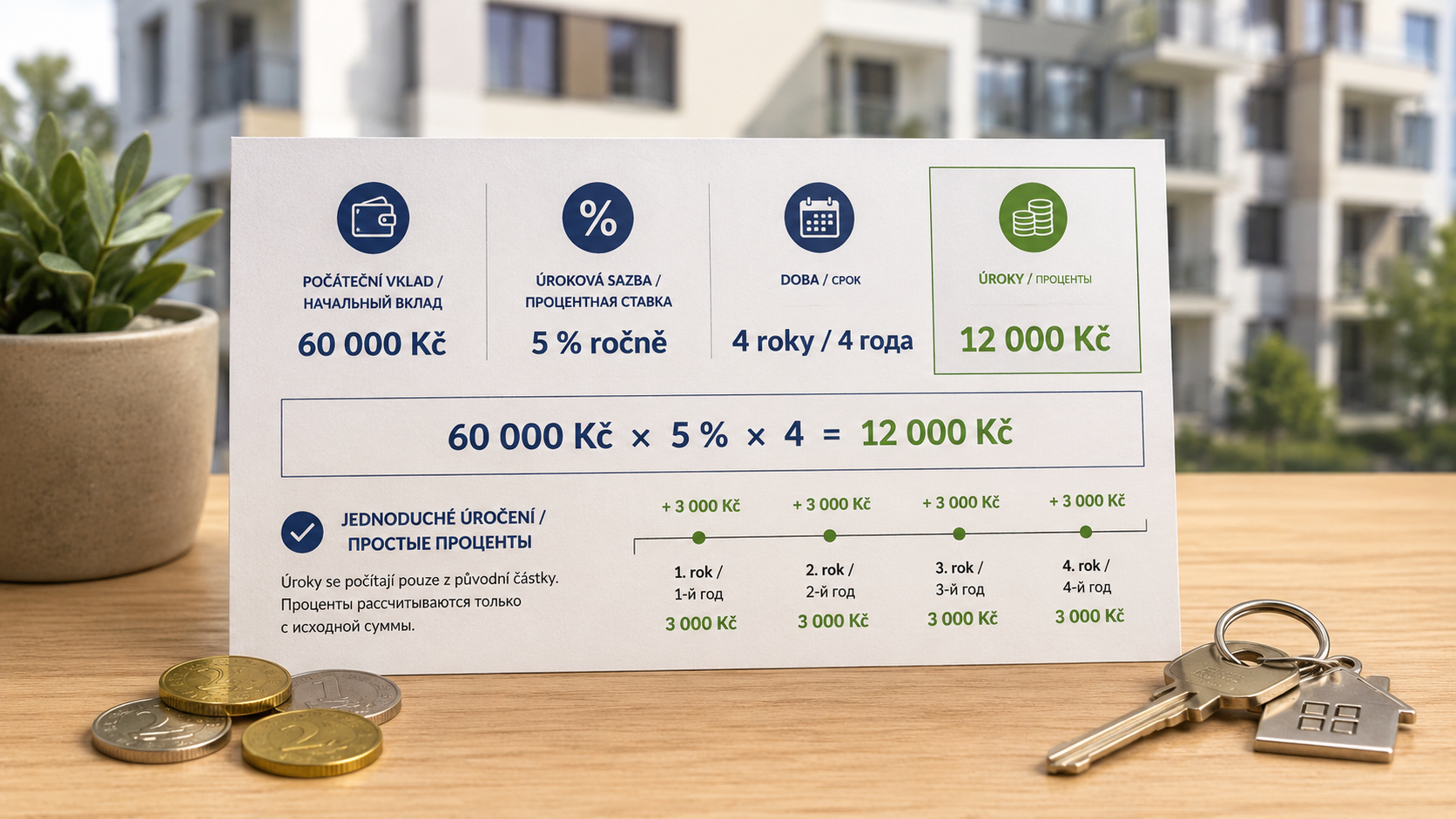
How Interest on a Deposit Is Usually Calculated
What Should Be Included in the Lease Agreement
A lease agreement for an apartment in the Czech Republic should not only fix the amount of the monthly rent, but also clearly describe the monetary deposit. The more precisely the parties agree on things at the outset, the fewer risks there will be when the tenancy ends.
The Czech Ministry of Regional Development also treats the monetary deposit as part of the tenancy relationship connected with the payment of rent, services, and possible obligations of the tenant toward the landlord (source).
| What to Specify in the Agreement | Why It Matters |
|---|---|
| The amount of the monetary deposit, i.e. kauce / jistota | So it is clear what sum has been handed over to the landlord |
| The date the deposit was paid | The period for interest accrual may be counted from that date |
| The interest rate | This reduces the risk of a dispute over the applicable rate |
| The deadline for returning the deposit after the tenancy ends | Helps avoid delays and claims |
| The procedure for setting off debts | Important in cases of unpaid rent, services, or damage |
| The procedure for the final settlement | Needed for a transparent return of funds |
| A handover protocol and photo documentation | Helps confirm the condition of the apartment upon move-out |
For the landlord, it is sensible not to gloss over the issue of interest, but to state it directly in the agreement. This does not worsen the landlord’s position. On the contrary, it makes the relationship more predictable. For the tenant, such wording is also useful, because they understand in advance how the return of the deposit will be calculated.
Can Interest and Costs of Managing the Deposit Be Set Off
Sometimes landlords consider an option where the agreement includes a condition regarding the costs of managing the monetary deposit. For example, the landlord states that they incur expenses for storing and administering the entrusted amount, and that the amount of these expenses roughly corresponds to the accrued interest. After that, it is assumed that the interest will be set off against such expenses.
This approach should be treated with caution. We are not aware of stable case law that would unequivocally confirm or deny the validity of such an arrangement. Therefore, it would be risky to use such wording as a guaranteed way to exclude the payment of interest. If the parties want to reduce the likelihood of disputes, it is more reliable to expressly agree on a reasonable interest rate or choose a transparent model for holding the deposit.
A Separate Savings Account as a Transparent Solution
One of the clearest options is to keep the monetary deposit in a separate savings account. In that case, the landlord can open a special account, place the deposit amount in it, and at the end of the tenancy return the deposit itself to the tenant together with the interest actually accrued. Tax and account maintenance fees may be deducted from the sum if they exist and are confirmed by an account statement.
The advantage of this approach is transparency. The parties do not need to argue about which bank rate should be treated as the usual one. There is an account statement showing the receipt of funds, accrued interest, withheld tax, and the final balance. This option is especially appropriate where the deposit amount is high or the tenancy is long.
The issue of the deposit and interest is especially sensitive against the background of the overall cost of housing in the Czech Republic. According to ČSÚ data, household spending on housing remains one of the significant items in the family budget, especially in Prague (source).

Source: ČSÚ
The downside is that not every landlord is willing to open a separate account for each tenant, and bank terms may change. Nevertheless, for agreements where the parties want to avoid uncertainty, this is one of the clearest mechanisms.
How Interest on a Deposit Is Used in the Actual Settlement
In practice, interest on the monetary deposit often becomes part of the overall settlement at the end of the tenancy. For example, the landlord believes the tenant has an underpayment for services or damage to the apartment. The tenant, in turn, reminds the landlord of their right to interest on the deposit for the entire tenancy period.
In such a case, the parties may carry out a mutual setoff. If the tenant has a debt, it may be set off against the deposit. If the landlord has to return interest, that amount is also taken into account in the final settlement. It is important that everything be documented in writing: the deposit amount, deductions, the calculation of services, damage, interest, and the final amount to be returned.
For both parties, it is better to avoid oral agreements. In the event of a dispute, the lease agreement, proof of payment of the deposit, correspondence, the handover protocol, photos of the apartment, and the calculation of deductions will all matter. The more documents there are, the less room there is for emotional conflict.
What the Tenant Should Know
The tenant should review the agreement before signing it. It is important to understand how the monetary deposit is described, whether interest is specified, when the deposit must be returned, and which sums the landlord is entitled to withhold. If the agreement contains wording that no interest accrues, this does not always mean that the right to interest has been lost. In residential tenancy, the law protects the tenant even against poorly worded contract provisions.
When moving out of the apartment, the tenant should request a written settlement. If the landlord withholds part of the deposit, the tenant should ask for a justification. If the deposit is returned without interest, the tenant may separately request a calculation of interest for the period from the moment the deposit was handed over until it was returned.
What the Landlord Should Know
The landlord should understand that the deposit is not additional income. It is monetary security that may be used only to cover the tenant’s actual obligations: unpaid rent, services, utility charges, or damage to the apartment. The remaining balance must be returned.
The safest approach is to include a clear provision on interest in the lease agreement in advance. This reduces the risk of later claims and strengthens the landlord’s position. It is also important to keep careful records: confirmation of receipt of the deposit, the handover protocol, photographs, the calculation of services, and a written explanation of all deductions.
When preparing and reviewing lease agreements, Get Home recommends not ignoring the issue of interest, but addressing it in advance. This helps protect the interests of both parties and avoid a situation where a dispute arises only after the tenant has moved out.
Conclusion
The return of interest on a rental deposit in the Czech Republic is not a new trend, but a legal rule that has been in force since 2014. The tenant has the right to interest on the monetary deposit, and the landlord must take this into account when preparing the agreement and making the final settlement. The main difficulty lies in the amount of interest if the rate has not been agreed in advance.
Therefore, the optimal solution is not to leave this issue open. The lease agreement should expressly state the interest rate, the procedure for returning the deposit, the rules for setting off debts, and the timing of the final settlement. The more precise the agreement, the less likely a dispute will be when the tenancy ends.

FAQ
Does the deposit have to be returned with interest in the Czech Republic?
Yes. In residential tenancy, the tenant is entitled to interest on the monetary deposit from the moment it is handed over to the landlord. This right is provided for in § 2254 of the Czech Civil Code.
What are kauce and jistota?
Kauce is the common everyday name for a deposit in tenancy. Jistota is the legal term, meaning monetary security or a monetary deposit. In the article, both terms refer to the amount the tenant gives the landlord as a guarantee of fulfilling obligations.
Can the agreement state that no interest accrues?
In residential tenancy, such wording may be problematic. If a contractual term reduces the tenant’s rights, it may be disregarded on the basis of § 2235 of the Czech Civil Code.
What interest rate must be paid?
If the rate is specified in the agreement and does not violate the tenant’s rights, the parties usually follow the agreement. If the rate is not specified, the issue arises of applying ordinary bank interest. The law does not provide a single simple rate for all cases.
Can a debt for utilities be deducted from the deposit?
Yes, if the debt is confirmed by a settlement statement. The landlord may set off against the deposit any debt for rent, services, utility charges, or damage to the apartment. Deductions must be justified.
What should be done if the landlord does not want to return the interest?
First, it is worth requesting a written settlement and referring to the tenant’s right to interest on the monetary deposit. If the amount is significant and an agreement cannot be reached, it is reasonable to seek legal advice.
What is best to include in a new lease agreement?
It is recommended to specify the deposit amount, the date it is paid, the interest rate, the return deadline, the procedure for setting off debts, and the procedure for the final settlement. This reduces the risk of disputes for both parties.