


Why a non-paying tenant in an apartment is not only a financial but also a legal problem
Evicting a non-paying tenant in Czechia seems like a simple topic only until a landlord faces it personally. In practice, the situation is almost always emotional: the rent does not arrive, utility payments keep increasing, the tenant promises to pay “next week,” and the owner feels that someone is using their property for free. At such a moment, it is very tempting to act quickly: open the door with your own key, change the lock, remove the tenant’s belongings, or at least enter the apartment and check what is happening there.
At Get Home, we often see that this is exactly where owners make the most dangerous mistakes. In Czechia, an apartment, even if it belongs to the landlord, becomes the tenant’s home for the duration of the lease. This is not just a practical formality, but an important legal boundary. As long as the lease agreement (nájemní smlouva) is in effect, the tenant has the right to use the apartment, and the landlord cannot arbitrarily “restore justice.”
The main risk is that unlawful actions by the owner can create far more problems than the rental debt itself. A non-paying tenant may still owe money, but if the landlord acts incorrectly, they risk facing a dispute over an invalid termination, a claim for compensation, a conflict with the police, and even criminal-law risk due to a violation of the inviolability of the home (nedotknutelnost obydlí).
This article does not replace a consultation with a lawyer, because every situation depends on the lease agreement, the amount of the debt, correspondence, the tenant’s conduct, and the evidence. But it will help you understand the main point: how to act properly, what you definitely must not do, and why in Czechia the approach of “I’ll go in and change the locks” almost always ends badly for the owner.
When a landlord has the right to terminate a lease agreement
In Czechia, a landlord cannot terminate an apartment lease simply because they changed their mind about renting out the property, got tired of the tenant, or consider the tenant an unpleasant person. For a notice of termination of lease (výpověď z nájmu), reasons provided by law are required. This is a fundamental point.
If the agreement concerns the rental of an apartment for residential purposes, the law protects the tenant more strongly than in ordinary commercial relationships. The landlord has the right to terminate the lease, but this right is limited. The reason must be lawful, specific, and correctly described in the notice.
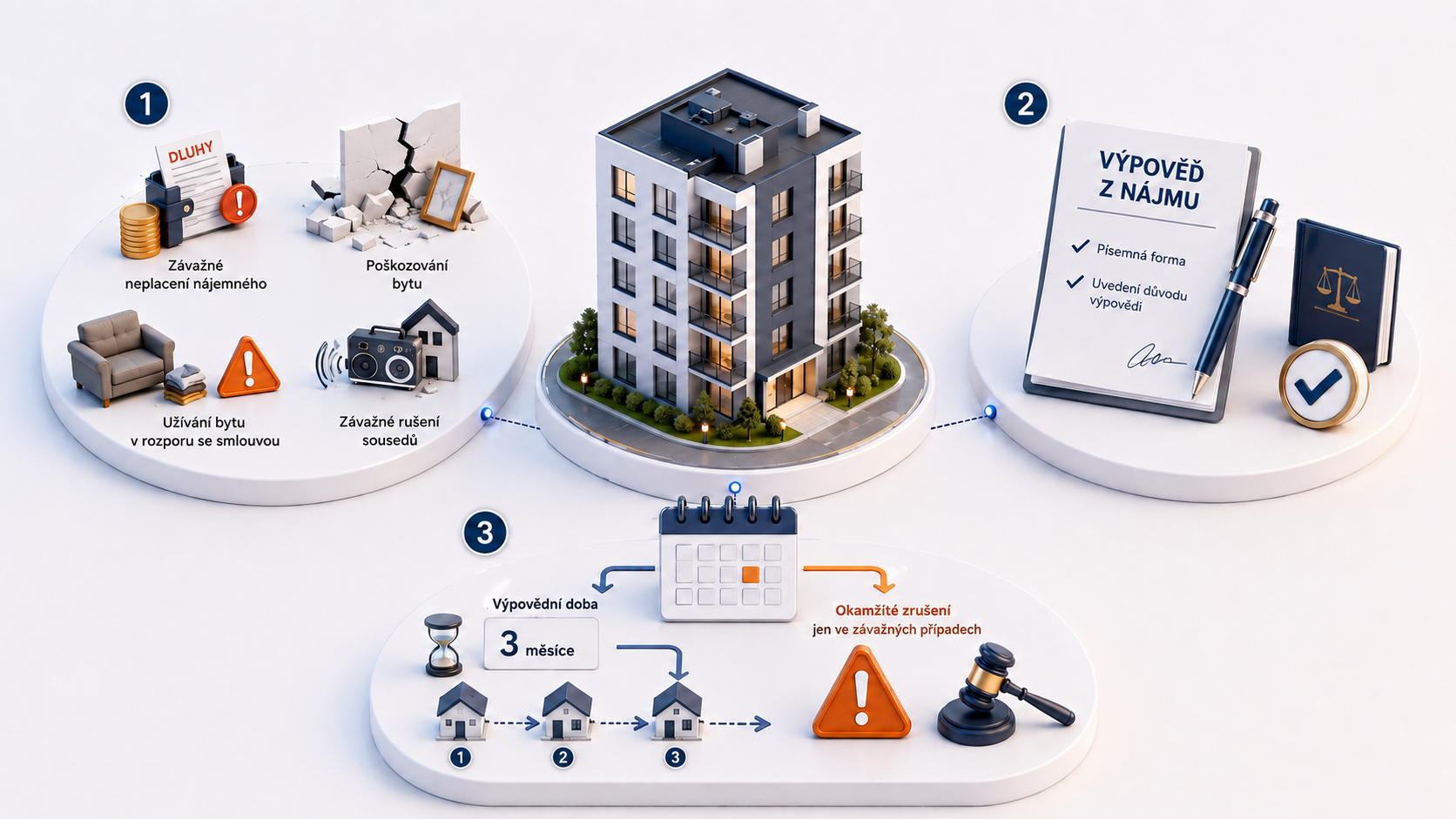
Typical grounds include a serious breach of the tenant’s obligations, for example substantial debt, serious damage to the apartment, use of the housing for an unintended purpose, or conduct that creates serious problems for other residents of the building. But it is not enough simply to write “the tenant is breaching the agreement.” It is necessary to understand the degree of the breach and choose the correct legal path.
In Czech law, there is a difference between ordinary termination with a three-month notice period and termination without a notice period, which is often called “immediate.” This difference is very important. If the tenant seriously breaches their obligations, the landlord may use termination with a three-month notice period. If the breach is especially serious, the law allows termination without a notice period, but only under strict conditions.
That is why the universal phrase “they are not paying, so we evict them immediately” does not work in Czechia. It is necessary to look at how many months have not been paid, whether demands were sent, how the notice was drafted, whether there is proof of delivery, and whether the agreement contains wording that contradicts the law.
Why debt for 1 or 2 months does not give the right to immediate eviction
One of the most common mistakes owners make is assuming that if the tenant has not paid for one month, the agreement can already be terminated without a notice period. In reality, debt for 1 month, and often even for 2 months, does not by itself give the right to terminate the lease immediately.
For termination without a notice period due to non-payment, the law focuses on an especially serious breach. In the case of an apartment lease, such a breach includes, in particular, a situation where the tenant has not paid the rent and service charges for at least 3 months. Until that moment, the debt is, of course, still a debt. It can and should be documented, payment can be demanded, consequences provided for by the agreement and the law can be applied, negotiations can be conducted, and evidence can be prepared. But this does not yet mean that the owner can immediately terminate the lease and demand that the apartment be vacated “by tomorrow.”
It is important here not to confuse two things: the right to demand money and the right to terminate the lease. If the tenant has delayed payment, the landlord has the right to demand repayment of the debt. But termination of the agreement is a separate legal step. And the stricter this step is, the more precisely the legal conditions must be observed.
In practice, we advise owners not to wait in silence. Already after the first delay, it is worth reminding the tenant in writing about the debt, stating the amount, the payment deadline, and the consequences of further non-payment. After the second delay, communication should become even more formal. But formality does not mean threats, self-help, or pressure on the edge of the law. It means competent letters, clear documentation of the debt, and preparation for the next step if the tenant does not respond.
What must be included in a notice of termination of lease
A notice of termination of lease (výpověď z nájmu) in Czechia cannot be written in the style of “we are tired of you, move out.” It must be in writing, delivered to the tenant, and drafted in a way that can withstand possible review in court.
One of the key elements is informing the tenant of their right to file objections and apply to the court with a request to review the lawfulness of the termination. In Czech, this refers to the right to ask the court to review the legitimacy of the notice of termination of lease (navrhnout přezkoumání oprávněnosti výpovědi soudem). If the landlord does not include this poučení, the notice may be invalid.
This is the very “disclaimer” that many owners do not know about. It is not a nice legal phrase added for solidity. It is a mandatory warning to the tenant about their rights. The absence of such wording can destroy the entire procedure, even if the debt itself is real and the tenant is indeed breaching the agreement.
The notice must also state the specific reason. It is not enough simply to write “due to a breach of the agreement.” It is necessary to describe exactly what the breach consists of: which payments have not been paid, for which months, in what amount, which obligations have been breached, when demands for payment were sent to the tenant, and how the tenant responded.
If the landlord wants to use termination without a notice period, they usually need to first send the tenant a demand to remedy the breach. In the case of debt, this means giving a reasonable deadline to pay the outstanding amount. If this is not done, such termination may be disregarded, and the owner will lose time and money.

What a landlord must not do under any circumstances
The most dangerous thing in a conflict with a non-paying tenant is trying to solve the issue by force or by “owner’s right.” The owner’s logic is understandable: the apartment is mine, the keys are mine, the person is not paying, so I can enter. But in Czechia, this logic is legally incorrect.
You must not enter the apartment without the resident’s consent. Even if the tenant is not paying. Even if they do not answer calls. Even if the landlord has a spare key. Ownership of the apartment does not automatically give the right to enter a home occupied by another person on the basis of an agreement.
You must not open the door with your own key. You must not change the locks. You must not remove the tenant’s belongings into the corridor, basement, or storage. You must not hold the tenant’s belongings as a “pledge” until the debt is paid. You must not disconnect electricity, water, heating, or internet if the purpose of such actions is to force the person to move out. You must not threaten, come with a group of acquaintances, or create a situation in which the tenant feels physical pressure.
All of this may look to the landlord like “self-defense,” but to the police, the court, and the tenant it may look like unlawful entry, self-help, damage to someone else’s property, or violation of the inviolability of the home (nedotknutelnost obydlí). In the worst case, it may involve violation of domestic freedom (porušování domovní svobody). Therefore, a landlord should familiarize themselves in advance with the content of Section 178 of the Czech Criminal Code (trestní zákoník), because the consequences of such actions already go beyond an ordinary civil dispute.
It is especially important to understand: the existence of a debt does not cancel the tenant’s right to protection of the home. The non-paying tenant remains obliged to pay, but the landlord does not acquire the right to act as a judicial enforcement officer. In Czechia, compulsory vacation of an apartment is not a private operation carried out by the owner, but a procedure that goes through the court and, if necessary, through enforcement of the decision by bailiffs.
The legal route: court, vacating the apartment, and recovering the debt
If negotiations do not help, there is only one legal route: court. It is unpleasant, long, and expensive, but it is this route that protects the landlord from even greater risks.
At the same time, it is important to understand that vacating the apartment and recovering the debt are not always one and the same process. In practice, separate actions are often needed: one direction concerns achieving the vacation of the living space, while the other concerns recovering arrears for rent, services, contractual penalties, damage, or other claims.
First, the lease must be properly terminated or it must be confirmed that it has already ended. If the tenant does not move out voluntarily after that, a claim for vacating the apartment is filed. The court assesses the agreement, the notice, proof of delivery, the lawfulness of the reason for termination, and the conduct of the parties. If the court rules in favor of the landlord, the tenant is obliged to vacate the apartment. If they do not do so voluntarily, the matter may then move to compulsory enforcement.
Debt recovery is a separate practical task. Here, calculations, payment history, the agreement, the apartment handover protocol, correspondence, service bills, arrangements regarding the deposit (kauce), and evidence of which amounts were actually not paid are important. Sometimes part of the debt can be covered from the deposit, but the deposit must also be handled carefully: it is not permissible to arbitrarily retain all the money without a calculation and explanation.
The court route is rarely quick. It requires time, nerves, legal expenses, and readiness to work with documents. But its main advantage is that it is legal. And in a dispute with a problematic tenant, legality is often more important than speed. An incorrect “quick” solution can set the owner back several months and create counterclaims against them.
Why negotiations often work better than conflict
Although the legal route goes through the court, in real life reasonable negotiations often produce a better result. Not because the landlord should be soft or tolerate things endlessly. But because the owner’s practical goal is usually simple: regain control over the apartment, minimize losses, and avoid creating additional problems.
If the tenant understands that the owner is acting calmly, consistently, and documenting every step, the situation changes. Emotional messages in a messenger are one thing. A written demand to pay the debt, a specific calculation, a warning about possible termination of the lease, and readiness to go to court are another.
By “pressing the resident,” we do not mean threats, nighttime calls, pressure on relatives, or visits without consent. Such an approach can work against the landlord. We mean something else: regularly and in writing reminding the tenant about the debt, demanding a specific response, proposing a realistic payment schedule, documenting agreements, confirming deadlines, and not allowing the situation to disappear into silence.
Sometimes the best practical result is to agree on a voluntary move-out. For example, the tenant understands that the debt is growing, court is inevitable, and costs may increase. In such a situation, it is possible to sign an agreement on termination of the lease, set a move-out date, the procedure for handing over the keys, the condition of the apartment, the calculation of the debt, and the repayment procedure. Such a document must be prepared carefully, because unsuccessful wording can again create a dispute.
For the landlord, it is important to maintain the position of an adult participant in the process: without panic, without unlawful actions, but also without passive waiting. The earlier competent communication begins, the higher the chance that the matter will not reach a complicated court conflict.
Table: what you can and cannot do when there is rental debt
| Situation | What you can do | What you cannot do | Why it matters |
|---|---|---|---|
| The tenant delayed payment by 1 month | Send a written reminder, state the amount and payment deadline | Immediately change the locks or demand that the tenant move out “today” | One month of debt usually does not give the right to immediate termination |
| The debt is growing for the second month | Strengthen written communication, prepare a calculation, check the agreement | Enter the apartment without the tenant’s consent | The apartment remains the tenant’s home |
| The debt has reached 3 months | Assess the possibility of termination without a notice period, send a demand for payment | Automatically assume that the tenant has already been evicted | Even with serious debt, the correct procedure is required |
| A notice of termination is being prepared | State the lawful reason, the amount of the debt, deadlines, and the tenant’s right to judicial review | Send a short message without the mandatory poučení | Without the mandatory warning, the notice may be invalid |
| The tenant does not open the door | Write, call at a reasonable time, agree on access | Open the door with your own key or enter with a locksmith | This may lead to criminal-law risks |
| The tenant does not move out after the lease has ended | Prepare a claim for vacating the apartment | Remove belongings, hold property, disconnect services | Compulsory vacation takes place through court and enforcement |
| There is debt for rent and services | Prepare debt recovery, calculation, and evidence | Hold all of the tenant’s belongings as “compensation” | The tenant’s belongings cannot be used as a tool of pressure |
Practical conclusion
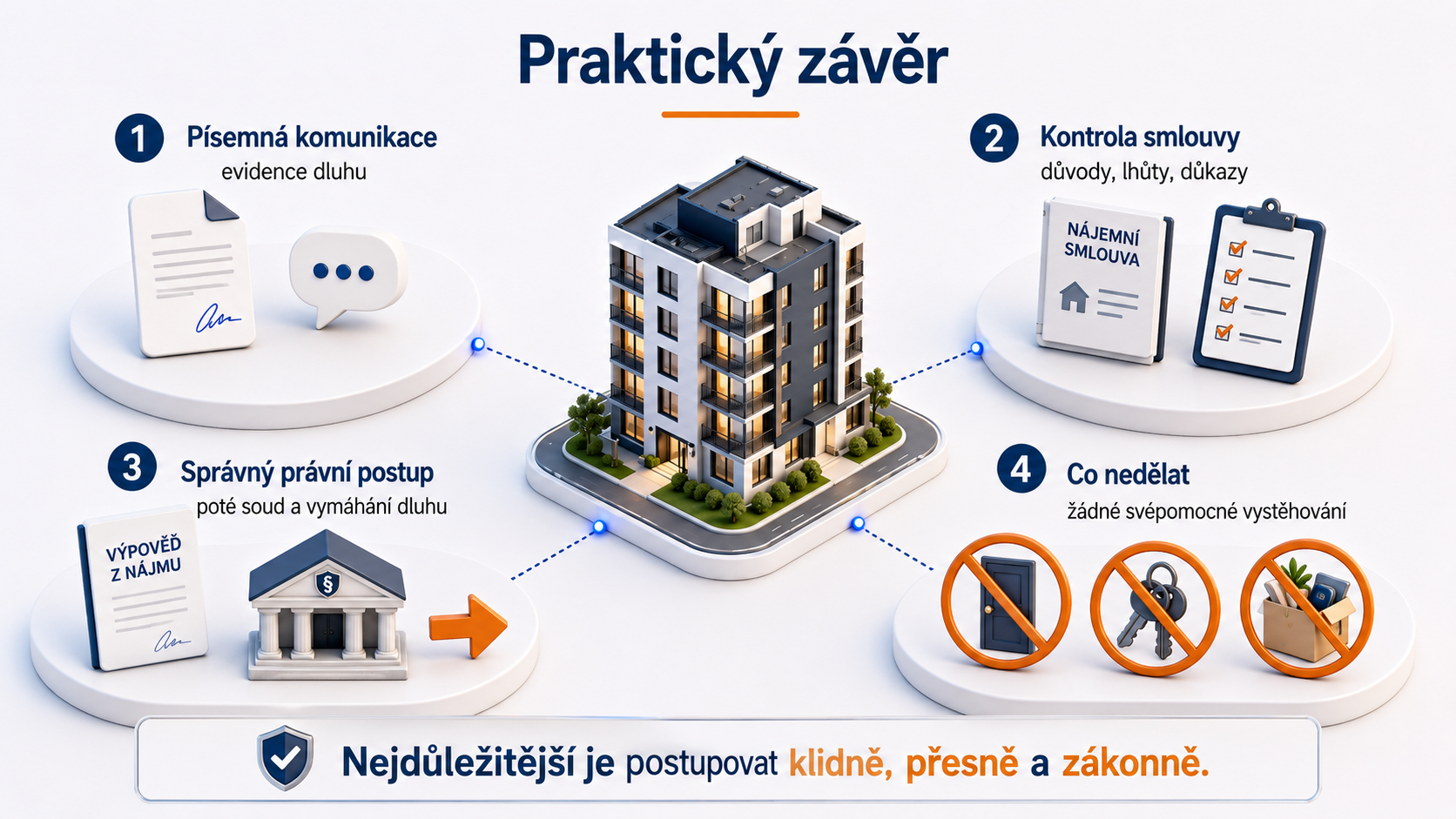
When dealing with a non-paying tenant in Czechia, it is important for the landlord not only to “be right,” but also to act correctly. The tenant’s debt does not give the owner the right to enter the apartment, change the locks, hold belongings, or evict the person by force. Such actions can cause incomparably more problems than the debt itself.
The correct strategy looks different. First, the debt must be documented and written communication maintained. Then the lease agreement (nájemní smlouva), amounts, deadlines, grounds for termination, and evidence must be checked. If the conditions are met, a correct notice of termination of lease (výpověď z nájmu) is prepared with the mandatory indication of the tenant’s right to challenge it in court. If the tenant does not move out, the matter is then resolved through court. The debt is recovered separately or within an appropriate legal procedure.
Yes, it takes longer. Yes, it is more expensive. But in a conflict with a non-paying tenant, the most dangerous path is arbitrary action. In real estate, sometimes the winner is not the one who acts fastest, but the one who acts more calmly, more precisely, and with documents in hand.
FAQ
Can a tenant be evicted if they have not paid for one month?
Usually not, if we are talking about immediate eviction or termination without a notice period. One month of debt gives the landlord the right to demand payment, send written reminders, and document the breach, but by itself it does not allow the landlord to simply terminate the lease without following the legal procedure.
Can a lease agreement be terminated if the tenant owes for two months?
Two months of debt is a serious signal, but for termination without a notice period the law usually requires a more serious breach, in particular debt of at least three months. With two months of debt, it is important to prepare documents, send demands, and assess the situation according to the agreement, but not to act arbitrarily.
What must be included in a notice of termination of lease?
The notice must be in written form, include the specific reason for termination, describe the breach, and, if the notice is sent by the landlord, warn the tenant of their right to file objections and ask the court to review the lawfulness of the termination. Without this warning, the notice may be invalid.
Can I enter the apartment with my own key if the tenant is not paying?
No. As long as the tenant occupies the apartment on the basis of an agreement, the apartment is their home. Entry without consent may be considered a violation of the inviolability of the home. A spare key does not give the landlord the right to enter the apartment at their own discretion.
Can the locks be changed so the tenant cannot return?
No. Changing the locks without a lawful basis and without voluntary handover of the apartment can create serious problems for the landlord. This is not a lawful eviction, but an arbitrary action that may lead to civil and criminal consequences.
Can the tenant’s belongings be held until they pay the debt?
In an ordinary situation, this is extremely risky. The tenant’s belongings cannot be used as a simple tool of pressure. If there is a debt, it must be recovered by lawful means, rather than turning the tenant’s personal property into an informal pledge.
What should be done if the tenant does not move out after termination of the lease?
If the lease has been terminated correctly, but the tenant does not vacate the apartment voluntarily, the landlord must go to court with a claim for vacating the apartment. It is not permitted to remove belongings, change locks, or physically prevent access on your own.
Can an agreement be reached with a non-paying tenant without going to court?
Yes, and in practice this is often the most reasonable path. It is possible to agree on a payment schedule, voluntary move-out, handover of keys, and written acknowledgment of the debt. The main thing is to document the agreements in writing and not use unlawful pressure.
Can the debt be covered from the deposit?
Sometimes yes, but only with a correct calculation and taking the agreement into account. The deposit (kauce) should not be retained automatically and in full without explanation. It is necessary to state which amounts are being covered, for which period, and on what basis.
When should a lawyer be contacted?
It is better to contact a lawyer before sending a notice of termination, not after a mistake has been made. Especially if the debt is already significant, the tenant is confrontational, does not accept letters, there is damage in the apartment, or the owner is planning court proceedings.